Wednesday, August 26, 2015

Why We Love Hedwig and Pigwidgeon


Owls; our most charming bird. Written and illustrated by Matt Sewell. Ten Speed Press/Penguin Random House. Release date: September 22, 2015.
British author, street artist and "birder," Matt Sewell shares his love and passion for owls by presenting brief narratives of fifty owls from all over the world. In a forward to the book, Martin Noble notes the world's fascination with these creature spans history and cultures.
However, this is less a field guide or informational book but rather this artist's celebration of one of his favorite birds. Short entries on each owl discuss folklore, cultural beliefs, or symbolism attributed by humans to this owl. The Woodland Barnyard owl is associated with misfortune. Conversely, the Little Owl is associated with Athena, the Greek goddess of wisdom, and symbolizes wisdom and good fortune. The book is organized by habitat (Woodland, Tropical, Wilderness, etc.). Each narrative includes the owl's scientific name, a short description focusing on a prominent feature or features of that owl (the huge and distinctive eyebrows of the Crested owl) and approximate size and general location. Most of the entries are accompanied by Sewell's distinctive, stylized watercolors,  familiar to readers of his earlier books and to those who have seen his graphic designs on products and large street muralsThe author's charming and quirky characterizations of each owl will certainly delight readers of all ages: he humorously comments on and depicts the scruffy appearance of the Tawny owl and the scowling face of a Long eared owl. 
Sewell concludes the book with a note on "Spotting and Jotting" (how to look for and keep track of owls) and a lovely thumbnail watercolor of each of the owls in the book. 
Sewell's love for and fascination with birds comes through on each page and his humorous observations and delightful watercolors make this a charming gift for birders of all ages. Also highly recommended for libraries with visual art collections and where interest in birding is high. 
Visit  Sewell's website to see more of his work. Check out a few videos on YouTube: the book trailer for Our Garden Birds (Ebury Press) and a 2014 interview. Be sure to visit Ten Speed Press (Penguin Random House) to learn more about this book and other titles published by this press.

Thanks to NetGalley and Ten Speed Press for giving me access to the e-galley.

Monday, August 24, 2015

A Block(buster) of a Book


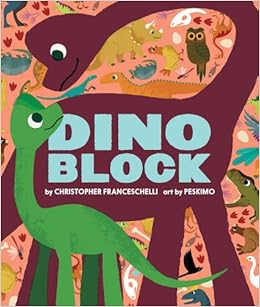
DINOBLOCK by Christopher Franceschelli with artwork by Peskimo. Abrams Appleseed, 2015. $16.95.

If you have a budding young paleontologist (and even even if you don't),  this book's inventive and colorful graphic design will delight and engage both children and adults. 

Two children  stop by the museum to "meet the dinosaurs" as the banner outside proclaims. Wait .... don't be quick to turn the page: the first two pages fold out to form a four-page spread of the diorama-style exhibit. 


But the children want to know:

WHO ARE THE DINOSAURS? 

and 

WHERE ARE THE DINOSAURS?

And the dinosaurs, peeking out from the jungle brush, call out:

HERE WE ARE

Pairs of two-page spreads combine to create clues and answers, comparing the characteristics of contemporary objects with dinosaur features. The design of the "clue" spread interacts with the "answer" spread and links the present to past. 

A tall building is compared to the Sauroposeidon, a dinosaur which reached heights of 18 meters (almost 60 feet).   

I AM TALL LIKE A SIX-STORY BUILDING ...

The straight-edged tab on the shared page of the clue and the answer emphasizes both the building's height and the long neck of the Sauroposeidon and gives children a peek into the prehistoric environment ...

Visit  Good Reads with Ronna to see the full review and find links to resources about the author and the illustrators. 


Friday, July 24, 2015

A Chill(ing) Book for a Hot Summer Night

Wylding Hall by Elizabeth Hand. Open Road Integrated Media, Inc. 2015.

A poem written by English Renaissance poet Thomas Campion prefaces this suspenseful and atmospheric story and foreshadows the dark events to come:

Thrice toss these Oaken ashes in the ayre,
Thrice sit thou mute in this inchanted chayre …

Go burn these poys’nous weedes in yon blew fire,
These Screedh-owles fethers, and this prickling bryer,
This Cypresse gathered at a dead man’s grave …

Then come you fayries, dance with me a round,
Melt her hard heart with your melodious sound …


In the early 1970s, a British record producer and manager of an up-and-coming acid folk band,  leases Wylding Hall, a large and very old country house in Hampshire, England, for the summer. The band’s popularity is just starting to take off and their manager hopes to give the band the time and space, in a remote area, to write new material and rehearse for their next album.  The young musicians are eager to move in and work on their music.

Much of the house, sections of which date back to Tudor and  Norman times, is unused and in ruins. The band occupies a newer, remodeled section and almost from the first, notice that things are not quite right.  An old caretaker warns them to stay away from the “Downs” after dark  and not to wander around in the nearby woods. A psychic visitor suddenly becomes frighteningly ill.  Lead singer and songwriter, Leslie Stansall, feels like an intruder and bassist Ashton Moorehouse wonders about a well-tuned piano in the unused house. In one of the story’s more chilling incidents, he finds a small, foul smelling room filled with dead birds. Singer/songwriter and lead guitarist Julian Blake discovers a library and becomes obsessed with some of its mysterious manuscripts.  While exploring the house, a visiting journalist also discovers the library--and finds it contains more than just some esoteric books. Amazingly, few of these disturbing  experiences are shared with the group, but for the reader, who knows what each character knows, the suspense and horror grows.

After a bizarre incident at a local pub, Julian unexpectedly vanishes. First days, then weeks go by without any sign of him. The band member search for him and even contact the local police, who are less than helpful. The stress of their missing friend,  coupled with mysterious happenings in the house, impacts the group's social dynamic. It becomes difficult for them to write and rehearse. Soon, everyone takes off with little to show for their efforts and diminished prospects for the future.

Twenty years after the event (when this short novel actually begins), an American filmmaker  interviews the band members and other witnesses in preparation for a documentary about the events of that long ago summer. Will she uncover the truth about Julian’s disappearance?

Author Elizabeth Hand’s creative use of the interviews  as a vehicle to tell the story enables the reader to see the story from many different perspectives. The interviews are intimate, personal,  sometimes painful, and reveal the characters’ young and  hopeful selves and as the middle-age adults they became. How the characters’ interact with each other, respond to their environment,  and, later, discuss their impressions and recollections of that summer in 1971, is probably one of the most compelling aspects of this story. The interviews make it clear how significant this summer was for each.

Enjoy this story for its chilling suspense, but stay for the author’s beautiful and evocative writing which invokes a strong sense of time and place. Hand writes knowledgeably of the folk music scene in England during the 1970s and tantalizes the reader’s imagination (and fears) by weaving in old traditions, superstitions, and haunting songs from British folklore.

References to drugs and sex, while not explicit, are part of the “times” and  make this hard-to- put down story appropriate for mature teens and adults. Hand is an award-winning author and critic. Visit her website and Open Road Media, Inc. to learn more about her.

Review based on e-galley from Netgalley.

Wednesday, July 15, 2015

The British are coming ... Again!


Tom Gates; Excellent Excuses (and Other Good Stuff). Written and illustrated by Liz Pichon. Candlewick Press, 2015.

While Paul Revere is probably rolling in his grave, Pichon's American fans will be rolling over with laughter as they read the next book in the hilarious saga of British fifth grader, Tom Gates.

Those who read Pichon’s first book, The Brilliant World of Tom Gates, will find that Tom, now on a two week break, is still up to his usual hijinks: finding new and improved ways of annoying his sister, Delia, devising the most ingenious excuses to get out of troublesome situations, eating his favorite snacks (caramel wafers), doodling, and hanging out with his best mate (friend), Derek.

Tom’s biggest hope is to find a drummer for his band, DOGZOMBIES and secure the band’s first gig. But in typical Tom Gates fashion, there’s a whole lot of everyday life-and his reaction to it-swirling around:  a bad tooth, his prank-playing cousins, the ongoingt rivalry with class smarty pants, Marcus, and the field trip from hell.  Oh, and as Mr. Fullerman, his teacher, keeps reminding him, there's still an overdue homework assignment to turn in. To give Tom a little incentive, Mr. Fullerman (who's wise to this procrastinating day dreamer) has sent one of his prize worthy, tongue-in-cheek notes home to his parents ...

 Visit Good Reads with Ronna to see the full review and links to great resources on the author and the series. Review based on advance reader copy.

Saturday, July 11, 2015

Soar with Misty Copeland's Firebird


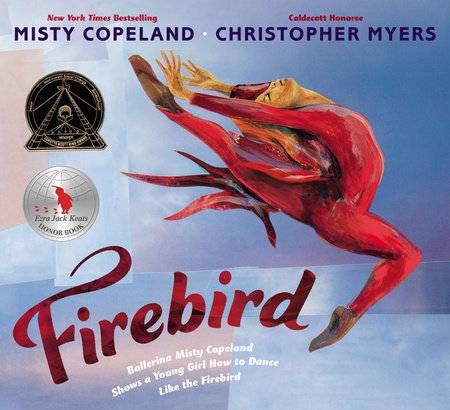
Firebird by


Firebird. Written by Misty Copeland and illustrated by Christopher Myers. G.P. Putnam's Sons, 2014.

Recommended for ages 5-8.
American Ballet Theater ballerina, Misty Copeland, shows a young girl how to dance like the firebird. Copeland, author of Life in Motion, has written a spare but powerful picture book about a young African American girl who dreams of becoming a ballet dancer. Daunted by the process, the young girl compares her ” gray as rain” self to the “swift as sunlight” Copeland, believing that she could never be as good as her idol. Realizing that the girl lacks confidence and is overwhelmed by what lays ahead, Copeland offers encouragement and support in a lyrical conversation between mentor and protégé:
“darling child, don’t you know
you’re just where I started …
your beginning’s just begun …”
Copeland assures the young girl that, despite the challenges and hard work (“…I  had a thousand leaps and falls …”), her ability will grow. One day someone will need her support:
“then they will look to you in wonder
and say …
the space between you and me is longer than forever
and I will show them that forever is not so far away”
Lovely ballet similes and metaphors are woven into a narrative as powerful, yet as graceful as the dancer’s art:
“ …Like me you’ll grow steady in grace
spread an arabesque of wings
and climb …”
And while the narrative is a conversation is between a beginning dancer and an experienced ballerina, Copeland’s message of determination and realizing your dream is an important and inspiring message for all of us.
Read more at Good Reads with Ronna.